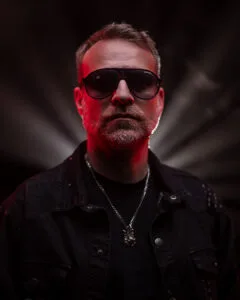
 — You chose the name Nightcrawler because, for a while, you were working a lot at night as graphic designer. Is Nightcrawler’s music something you also like to make when the sun goes down?
— Yes, but too many times at night I’m tired, so I bring that moment closer by closing the blinds and turning on the red studio lights. when I produce, I like being in the dark, with dim lighting.
— In the ’90s, you were part of a hip-hop crew—something you revisited slightly in the track “Savage.” Can you tell us more about those early steps and how they may have influenced your later career?
— It was a great period and I keep great memories of it. Everything was very organic. In fact, I can tell you an anecdote: now, when people release music, what they want is for it to have as much diffusion as possible, to have maximum visibility and reach people. Back in my hip-hop days, with the demos, it was the opposite. When someone would give you a demo, they’d tell you, “Don’t pass this on to anyone.” It was like it wasn’t for everyone, and having it became something very exclusive. Often you had to earn it just to get it passed around. If you didn’t stand out in the scene in some way, you weren’t really “entitled” to it. Later, everything became a bit more commercial, and demos were sold in specialized stores alongside graffiti fanzines, etc., but I remember that for a while it was like that.
— After a few years away from music, in 2011 you decide to return to composing, this time moving into electronics. What motivated you to make synthwave?
— Seeing a genre start to emerge that connected with all the imaginative world inside a kid’s mind—movies, 80s TV shows, and all that. It was incredible—that’s what motivated me!
— Your music is inspired by movie soundtracks that marked your childhood, like Robocop or Escape from L.A. Did you fall for the music the first time you watched those films, or is it something you’ve rediscovered over time?
— Yes, of course. I always loved music, but I never imagined that one day I would be making this kind of music. It’s just the way life turns and surprises you.
— John Carpenter is without doubt a very clear influence in your music. Don’t you think he should be recognized as much as a musician as a director?
— Well, I think he already is. In fact, I saw him live at the Primavera Sound festival.
— Continuing this line of thought: do you see all this retrowave culture as only nostalgia, or do you think there’s something more behind the fascination with the ’80s?
— It’s nostalgia and evolution. Lots of today’s bands have influences from the ’80s.
— Your first EP, Bassferatu, is from 2012. How do you see it with the perspective of time?
— Now it sounds like a demo… ha, ha, it was still very raw.
— Your next two EPs, Knight Rider and Road Blaster, remind me—at least visually—of Kavinsky. For many of us who discovered the scene thanks to his music and the Drive soundtrack, that’s the image we associate with synthwave. How do you feel about the moment when synthwave starts becoming fashionable?
— Right now, at the point I’m in, that era feels more distant, because I’m focused on a different kind of electronics. But I have very good memories of my time in synthwave. It was something incredible that probably won’t happen again. Being a pioneer in a genre—being born as a producer in a genre that’s also just being born—those are things you can’t plan. They just happen. And that’s how it was. It’s something I’ll always be very proud of as an artist.
— Metropolis, your first full-length, is like a science-fiction movie soundtrack. How do you develop the concepts behind your records?
— I imagine they’re movies and the songs are their soundtracks : )
— From Strange Shadows onward, you’ve also been inspired by Italian horror/suspense cinema. Do you like soundtracks by Goblin or Fabio Frizzi? What feelings do you want to inspire in the listener with this material?
— I love them! The basic feeling I want to convey is the atmosphere of dark horror and an immersive audio experience.
— Beware Of The Humans, your second album—couldn’t be a more fitting title for the moment we’re living in. Do you think there’s room for optimism in the world we live in? And in your music?
— The world is complicated right now on many levels… wars, inflation, technology vs. humanity… it’s starting to feel a bit dystopian even, so I wouldn’t rule out an apocalypse. As you can see, I don’t really look at it from a very optimistic prism, haha.
— With this album, you start broadening your influences toward darkwave and dark ambient, and you say your music is itinerant and can evolve. After so many releases and years working as Nightcrawler, how do you make sure you don’t repeat yourself?
— In artistic disciplines, the usual thing is to have a style, choose a path, and try to be the best in your field—but that bores me. I can’t imagine making synthwave all the time… or always darkwave, etc. So I like to play with all of them. That said, there’s always a common denominator: my music is dark—and I don’t think that will ever change. I know that can be complicated for branding, because maybe it’s harder to follow an artist who keeps evolving, but to hell with branding… I can’t conceive making music unless I’m doing what I feel like in each moment.
— After recording a track with Maxthor, titled “Vanished,” you begin including more compositions leaning toward a darker pop or darkwave direction in your records. What kind of singers do you like for your tracks? Is there something common among them?
— They must have dark or melancholic voices.
— Visionary, in your words, is focused on your own life and it felt like personal catharsis—like therapy. Does music help you know yourself better?
— Music is basically my best psychologist and therapy… the dopamine of finishing a track, feeling proud of it, and then hearing it on loop—those are among my best therapies, along with sport, of course. It’s a cliché, but exercising has been helping me a lot, and I recommend it to everyone.
— You say you prefer dark music to cheerful music. What have you been listening to lately that fits into that category?
— Belief Defect.
— As for the directors you like, you’ve mentioned among others Gaspar Noé or David Lynch. Is there a modern/new director you’d love to work with?
— Yes, Panos Cosmatos.
— Malevolent Forces, your latest work to date, is the most physical and visceral—where tension feels most palpable. How do you manage to add that touch of tension that characterizes your music?
— It just comes out. It’s innate. I don’t have any specific formula.
— Resident Nightmares is about your nightmares. What scares Nightcrawler?
— The tax declaration… or seeing myself alone in the middle of the sea, not knowing what’s underneath… among many other things…
— We always like to ask questions about the setup/equipment: what musical tools have you used on this latest EP?
— Basically all VSTs: the Zebra2 synths, Diva, DS Thorn, and the Hive.
— Last year you released a remix EP of Cold Transmission artists. How did the idea come about?
— They asked me for a remix for one of their artists, and I told them: hey, what if we make an EP and I do several? I’d been thinking about this idea for a while, and they said yes… it was one of those blessed coincidences that they reached out and I also had it in mind.
 — What can you tell us about your contribution to the documentary THE RISE OF THE SYNTHS?
— Being part of a documentary among the pioneers of the genre is huge, and on top of that it’s narrated by John Carpenter—something that feels like history. Maybe one day my grandchildren will see it and say: “Look, grandpa was involved in that whole scene.”
— How was composing the soundtrack for the arcade Jägermeister Galaxy Hunter?
— I did it the way I always do, but this time the world-building and the script behind the project were given to me.
— You’ve had a long relationship with Jägermusic. How have they helped promote your music?
— They were key. I hadn’t planned to do live shows as Nightcrawler, but that’s exactly what they were looking for: building a roster of artists to play at major festivals on the stage they set up. So if I didn’t have a live act, I couldn’t be there. They convinced me, and my second live performance was on a huge stage at the SOS 4.1 festival in Murcia. I started “with the big guys,” as a very underground and emerging artist… it was incredible.
— Related to this, you’ve played on the Jäger stage at SOS, at Primavera Sound, and at Ombra. Do you feel better in festivals where they already know your musical style?
— Yes, of course. It’s always better when the audience is from your niche / musical scene.
— Since Stranger Things was important for popularizing synthwave, did you like the series ending?
— I watched the first two seasons and loved them. But in the third, I started disconnecting—it felt like too much at once, and honestly it’s a series I haven’t finished.
— We want to ask you about two of your most recent collaborations: “Ghostless” with Spammerheads and “Oscuridad Sintética” with Dark Vektor. What can you tell us about them?
— Collaborating with artists is something I love—not just because of creative synergies, but because many times a collaboration also leads to a great friendship.