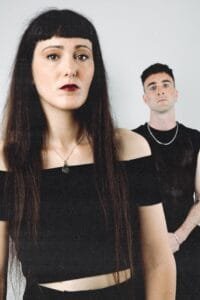
 —Both of you come from a theatrical background—curiously, that’s also the case for the Mexican band La bande son imaginaire. How did the transition happen from performances combining poetry and music to focusing on music alone? I also read that, at the beginning, you appeared dressed in white—is that right?
—We began to dedicate ourselves fully to music while we were still studying theater. We needed freedom and a break from our studies to start creating our own project.
At first, we did wear makeup and dresses in white. But gradually, we no longer felt the need to embody these characters, or even to hide behind them in a way; we wanted to be more ourselves.
—How has this theatrical background influenced the music you make? Is it reflected only in your live performances, or also in the way you compose?
—Our theatrical background doesn’t influence our composing style, but rather our writing. However, we draw heavily on it for our live performances; it taught us to listen to others, to be grounded, to improvise…
—Where does the name “Potochkine” come from?
—Potochkine is a word invented by a child. It was Hugo’s goddaughter who refused to pronounce the name Pauline, like children do when they’re testing adults… And for a week, she kept saying this word. We decided to keep it
—Libérez Votre Imagination was the title of your first EP, released back in 2016. In several interviews, you’ve talked about the importance of keeping your inner child alive. How important is imagination in the world of Potochkine?
—Imagination is everything for us and it’s the starting point of our project.
As childs, we were both very creative, living in our inner world, creating games, worlds, languages… Imagination is our magical power in a way.
—You collaborated on a tribute remix album dedicated to the Italian band N.O.I.A. Honestly, I didn’t know them before. Were they an influence on your music? What made you decide to take part in the project?
—Actually, we never listened to N.O.I.A before this proposal. It’s the label who reached us to make this remix. It was at the beginning of the project and we were glad to do it.
—On your first album, we can already hear your influences—for example, “Dans ta Face” sounds very punk. If I’m not mistaken, that influence comes from Pauline, who played in rock and punk bands. How did punk enter your life, and how do you express it within Potochkine?
—Pauline: Personally, I don’t think “Dans ta face” sounds punk. Punk is a part of my life from a very young age; I love the sound, the violence and the urgency of it. The screaming vocals and guitars. I later rediscovered that kind of love in EBM and also in some techno tracks.
So I don’t even think to express it within Potochkine, it’s just natural.
—In “Jumeaux”, we can clearly hear Hugo’s interest in electronic music—and you’ve also admitted that you’ve been a clubber. What kind of dance music do you prefer? Have your tastes evolved over time?
—Hugo: Techno is my absolute love and I discovered it with artists like Jeff Mills, Sandwell District, Robert Hood, UR, Klock, Dettmann, Efdemin, Blawan…
But techno also encouraged me to find new paths and other genres like dubstep, dnb, ambient or industrial. Digging new tracks and artists is something I ever did even on my metal or hip hop journey. I think tastes evolve all your life time and that’s what is very interesting. But my first loves are still the same.
—Since Mythes was born for the theatre, did you compose it differently? I mean—did you write the music after attending rehearsals, shaping it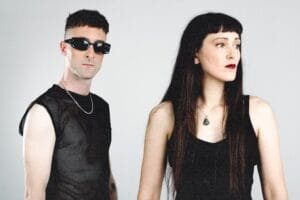 around the performance?
—Yes, we composed Mythes on stage during creation and rehearsals of the plays. It was a long process of 3 years. And of course, we had to create according to the dramaturgy and the director’s instructions. So it’s a total different process than create an album for instance. But we learned a lot and we keep great memories of this period
—About the lyrics: Pauline is the one who writes them, right? Do you find it more difficult to connect with French-speaking audiences—or do people understand the message through the performance even if it’s not immediately obvious?
—Pauline: yes, I write all lyrics. And I don’t really know if it’s more difficult to connect with French-speaking audiences…
The use of words is very important for us and as we play a lot outside of France, people are often telling us they don’t understand every lyric but they get the intentions and energy of the lyrics. Because we think voice & words are like a sort of magic; the brain interprets it in a special way.
Also French carries a certain rhythm, a tension, something sharp and percussive that becomes part of the music itself, even for people who don’t understand the words. We don’t expect everyone to understand the lyrics in a literal way. What matters to us is how the voice moves, how it hits the body, how it interacts with the sound. In that sense, the distance created by language can actually open something. It allows people to project their own meanings, their own emotions, without being locked into a specific interpretation.
Even if the words are in French, the energy, the emotions can still be fully shared.
—Hugo, you now compose and perform live with modular synths. Do you prefer this way of working compared to using computers?
—Hugo: I’d say the two are complementary; I chose a hybrid setup because I love both. Our entire studio is a kind of ecosystem—that’s how we designed it. Virtually everything can interact with everything else. And what’s incredible about modular synthesizers is that it’s a real dialogue, a relationship even, with the instrument itself. I start patching, I have an idea in mind, but modular synthesizers always surprise me, sometimes taking me in a direction I hadn’t imagined. It’s not just a performer like a computer, in my opinion; it’s all about the patching. I also like to think of it that way, as a playing partner.
—How would you label your music—EBM, darkwave, or something else?
—We don’t really like style labels, especially when talking about Potochkine. Our music is influenced by many different styles. But to put it simply, it’s a mix of EBM, techno, dark ambient, a bit of industrial, and experimental.
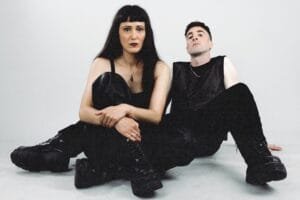 —In one interview, you said that Sortilèges was somehow connected to the pandemic and that very strange period. Could you tell us more about that?
—Yes, that’s true. We composed, produced, and recorded Sortilèges entirely during the pandemic. We were in Toulon at the time, and the pandemic hit without warning… We thought it was the perfect moment to create an album. It was a strange time for everyone. This sudden confinement at home, a complete break. But we were lucky enough to be in the countryside, and we decided to disconnect from everything else to focus on our music. We have very fond memories of it
—The song “Préferer Se Taire” (and the video) is about street harassment and intimidation of women in big cities. Was it important for you to make that theme visible, and to address it directly?
—Yes, making problems visible and talking about them is essential. Saying “Préférer se taire” is ironic because, on the contrary, today it is an absolute necessity.
—Sang d’Encre is your lastest album and I would like to talk about two songs, first “Tristesse Fantasmée” sounds a bit more upbeat, I don’t really know how to describe it. Can you tell us more about this track? Are more songs going to follow this path?
—Yes it’s true,a bit more upbeat. It’s a track focusing more on rhythm and strange melody. We like to make tracks like this sometimes; we’ll see in the future if we continue to follow this path…
—The other track that caught my attention is “La Source”, a long experimental song that we can find at the end of the album. Can you tell us more about this?
—”La Source” is an initiatory journey. We got lost in the hills when we were living in the south of France and there was a very special place there, in the forest. A black iron door embedded in the rock. It was actually the beginning of our inner journey for the creation of this track. We made a lot of field recordings, strange editing and stretching, trying some mystic sound design.
What we aim for this track is everybody makes their own interpretation of it with their own imagination.
—Among the remixes you’ve done, I particularly enjoyed the Absolute Body Control one. How do you approach remixing? And is there any band you would love to remix next?
—Remixing is a good exercise and we have different approaches according to the song. When Absolute Body Control reached us to made one, we were super happy and proud of it because it’s a band we love and respect a lot.For now, we don’t do remixes anymore cause it takes us a lot of time and we want to focus on our own tracks right now.
—Last year we saw you live in Madrid—how was your experience with the Spanish audience?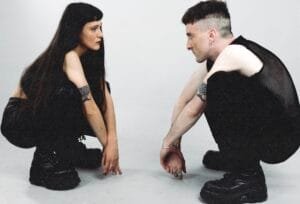
—Really good actually. We can’t wait to play again in Spain Saturday night.
—One thing that caught my attention was that you maintain visual contact a lot of the time, something that we don’t see in many bands. Is that your way of communicating
—This is our way of interpreting our music live; perhaps it has to do with our theatrical background; the fact of addressing the intentions and the text to the audience.
—What are your plans for the future? Would you like to do another soundtrack for a play?
—For the future, we want to develop even more Potochkine and play in venues and countries we have never gone to. In June, we will start to work on new tracks and ideas… And this summer, we have few important and exciting gigs so we prepare ourselves for those.But yes, we would love to work on another soundtrack for theater or cinema.
—And finally, what can we expect from your concert at Dark City Fest?
—Be ready for it…