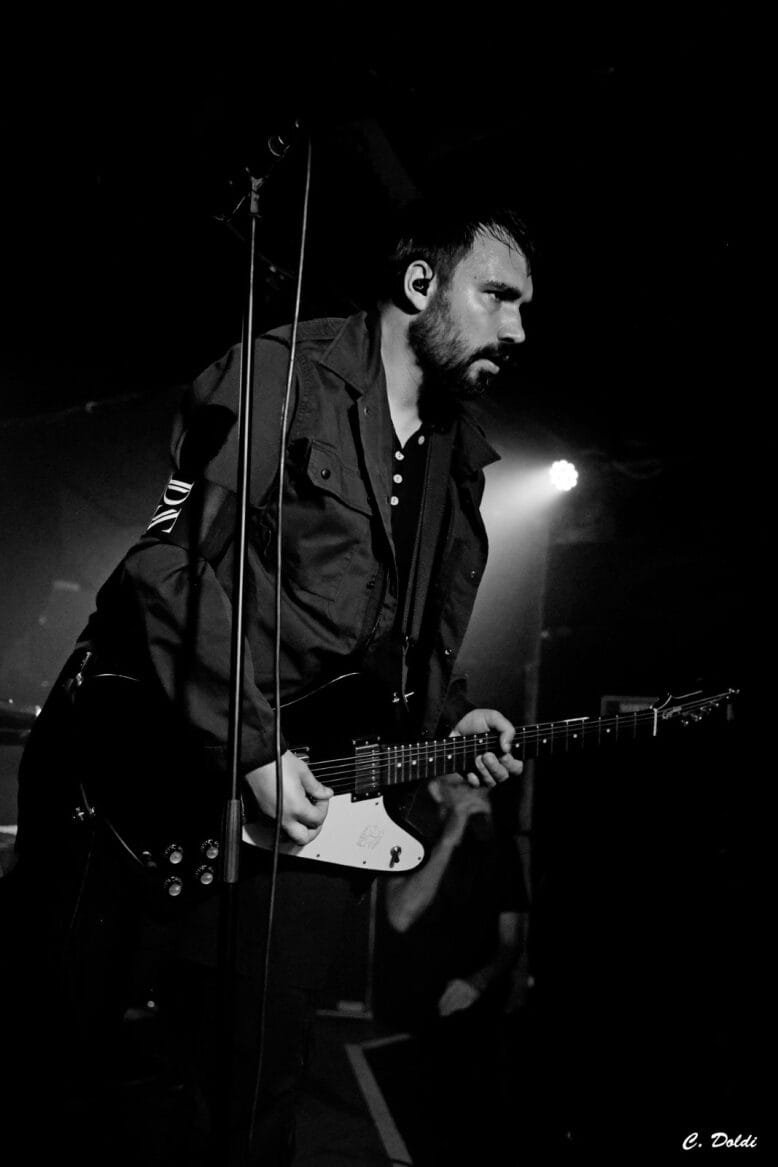
We discovered the neo-industrial band Divine Shade back in 2020 with the release of their EP In the Dust. Even then, we were struck by the intensity and boldness of their music. They continued to surprise us with their single “Stars” and the electronic project of their founder. That’s why we wanted to talk to Remi Thonnerieux, also known as Ren Toner, about the beginnings of the band and their spectacular debut album Fragments-Vol.1. Although, as we mentioned, we already knew their music, it was their performance at the Madrid festival Santuario that showed us what a great band they are.
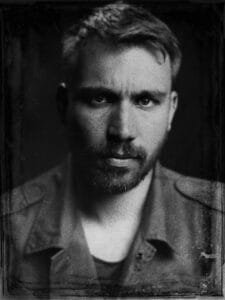 —In an interview you said that you started Divine Shade after being in some other bands. Why did you start this project back in 2013/14? What was your aim back in the day?
—Ren Toner: At the time, I was 20 years old, and my intention was to create a project where I would be the main driving force. Previous projects often ran out of steam: yes, we were teenagers and not very serious, but also real bands whose motivation relied on a collective spirit. From my perspective, that was also a major fragility in terms of perseverance. So it felt safer and more responsible to know, consciously, that no one would fight as hard as I would from now on.
—You have described your music as sincere a few times. Do you think that we are living a period in which music is missing its sincerity?
—”Success” is a puzzle in art. The mainstream has always embraced addressing the largest audience through unifying codes, although the underground often says it wants to break free from them, it actually works in a very similar way. In 2026, with the weight of algorithms, communities have closed in on identifiable codes, favored both by algorithms and programmers. In this context, the idea of a completely unique sincerity inevitably becomes fragile.
—I think that the clearest influence in your music is NIN. How has Trent Reznor influenced your way of making music?
—Trent Reznor was a true revelation when I discovered him, and Nine Inch Nails became a model for me. The quality and precision of his work in every aspect constantly pushed me to question my own, never settling for the minimum and aiming for an almost obsessive coherence.
—And to end up with the influences, in most of the descriptions of the band, there are references to coldwave. Has the original French coldwave been important for you?
—Not really, no. French coldwave didn’t really influence me, even though I have a lot of respect for the bands. My musical universe comes more from other sources.
—The first song that you composed for the band was “From the Sky” when you were still a student. Do you remember the moment of writing the song?
—Yes, I remember it very well, and “From the Sky” remains today one of my favorite songs to play on stage, because that’s where it all began.
—How do you see your EP From the Sky, released in 2014, in hindsight?
—Today, I look back at this EP with a lot of fondness. Even if the theme wasn’t exactly that from the start, From the Sky, for me, tells the story of a young boy discovering that music, like for his spiritual mentors, can give meaning to his life.
—What happened between 2014 and 2020? There were no new songs in those years, right?
—Between 2014 and 2020, personal cataclysms pulled me toward a form of self-destruction. Some things collapsed, while others struggled to survive in the darkness. Artistically, I felt that the naïve child of the first EP was only clumsily imitating his masters. Facing the blank page, I saw myself as an impostor. Silence then became a necessity, almost a rite of passage. The voice that had spoken until then was not yet my own.
—The second EP appeared in 2020 and the evolution from the first one is clear. The sound is bigger and deeper. How would you describe your evolution during those years? What did you learn?
—I went back to the basics, using real, organic instruments, but the real work happened within me. I realized that Divine Shade would become a project with a meta narrative. This EP explores impostor syndrome: trapped in a prison of my own making, suffocated by my influences, unable to find confidence, drifting in a sense of depersonalization. In the end, it’s a story about finding a way to survive creatively.
—For In the Dust, you created a short film divided into 4 episodes/videos. Can you please tell us more about the making of this? 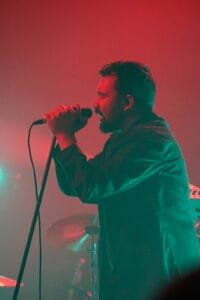
—In the Dust was the most collaborative period of the project. In retrospect, for me, it doesn’t quite align with post-punk or darkwave aesthetic expectations. But, I love its charm, it feels like an unconscious world within the universe of Divine Shade. And with what I just mentioned earlier, one could almost say that the short film doesn’t really tell what you see on screen.
—After this EP, you started collaborating with Chris Vrenna, who remixed some of your songs. How did you meet him?
—The only thing I can really say is that I contacted him directly. We hit it off immediately, and it was a true honor to collaborate with him. Chris is very friendly and passionate, I remember playing him “Stars”, which he liked, and then remixing it gave me an extra spark of motivation. I hope we’ll collaborate again.
—The first idea for Fragments was 3 Eps and then it became a full album. Why did you decide to do it in this way?
—Originally, I had composed enough songs to release a trilogy of EPs. It was also fairly strategic: planning multiple highlights over several months or years. Very quickly, I realized that I wouldn’t allow myself to experience new, immediate creative sensations if I waited for each EP to come out, and I risked feeling “out of time.” So I decided to merge everything into a single album, since it was all part of the same story. I could then tell new stories in the next “fragments.” I can’t say yet how many there will be, but a second one is certain. I don’t know yet if it will be an EP or an album.
—The album was self-released thanks to the help of your fans. How was the experience?
—We had already done a crowdfunding campaign for the short film In the Dust. It was really nice to see that people wanted to know what would happen next in the story of Divine Shade, and for that, I am very grateful.
—Talking about the album, you have spoken about your self-fulfilling prophecies. I am really curious about this, can you please explain it?
—Everyone tells themselves a story to face life. For me, music plays this role with self-fulfilling prophecies: it allows me to feel and process my wounds, and, in a way, to plan my healing and influence my future state of mind. That’s why I always try to find positive and resilient outcomes in my lyrics or in the concept of my albums. Because once a track leaves the studio, it begins to transform my reality.
—”Hate And Oblivion” was based on some health issues that you had, right? Canyou please tell us more about this and how affected your music?
—”Hate And Oblivion” was born from a peak, dark period in my personal life. A deep anger almost consumed me, leaving both visible and invisible wounds. My eyes burned even when closed, and the light of the world was unbearable to me. I felt trapped. I had to relearn how to reconnect with myself, with life.
—Thanks to the tour with Gary Numan, you met Steve Fox-Harris, what can you please tell us about his collaboration in “Oublier”?
—Steve is an humble and kind guy, I had the impression he just wanted to share the joy of making music. I remember when we talked about it, I was so happy. And when I received his guitar tracks, the song immediately became a top priority for me, as both the theme and the collaboration were so inspiring. Whether it was Steve, Chris Vrenna, or Chris Payne, these collaborations made me appreciate even more that period before Fragment-Vol.1, when I realized that the most important thing was simply making music.
—Some tracks of the album have a very elaborated electronic part, such as “Heaven”. What kind of electronic music are you into these days?
—My electronic inspirations are diverse, especially cinematic ones: for example, the soundtrack of the film Annihilation (2018), I love the track “The Alien” by Ben Salisbury and Geoff Barrow. I also enjoy certain tracks by Daniel Avery, Jon Hopkins, Maenad Veyl, and Amelie Lens. In fact, I like a lot of things, but I don’t want to “master” the subject. I’m such a fan of industrial music that new releases often move me less emotionally. I realize that, often, it’s the idea—the fantasy I create around a style or an atmosphere—that becomes a true creative resource for me.
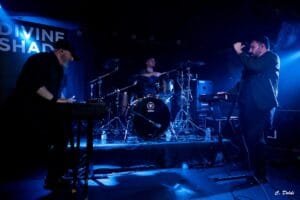 —How do you decide if you are going to sing a song in French or English? You said that in your native language, the tracks are more personal, right?
—In both cases, my lyrics remain personal. Sometimes, I just feel like I’m not bringing anything interesting, or that my command of the language doesn’t fully allow me to on a particular track. At that point, the voice becomes an instrument, and the language itself becomes part of the exploration.
—Do you try to give a positive perspective with the album? Do you think it’s still possible to be optimistic nowadays?
—I always try to maintain perspective. Optimism isn’t naive, it means acknowledging difficulties without letting them consume you, and looking for those small lights that help you move forward. I believe that what defines human beings is this ability to adapt, to find resources even in the darkest moments.
—You record mainly with analogue gear, don’t you? Why do you prefer it?
—Quite simply because I find analog gear has more character. Equipment saturation creates new sensations, for example. With advances in AI or even high-end plugins, a lot of soundscapes among artists in 2026 start to sound similar. For me, using organic gear allows you to recover that charming human imperfection. That said, there are very good plugins that I also use from time to time. And having everything on a computer has allowed many young musicians to make music without having to spend astronomical amounts on a synth that only makes one color.
—You do the artwork of the releases, right? What’s your inspiration for it?
—Exactly, I do watercolor. My influences are fairly predictable: I love the works of Francis Bacon, as well as the drawings and paintings of David Lynch (even though at first I didn’t really know his films, which I’m now discovering and adore).
—Divine Shade has opened for great bands and artists, especially The Sistersof Mercy, The Mission, Gary Numan and New Model Army. What’s your best memory of these concerts/tours?
There are so many good memories, it would be hard to choose just one. But for me, the most striking was what Gary Numan told me: sometimes, there are people who make you feel illegitimate, who call you a copy… as if the great masters hadn’t had masters themselves. And he made me understand something powerful: “Your own story is unique.”
—What happened with your side-project Ren Toner? We really liked the EP you released in 2022.
—I took a short break with Ren Toner, because opportunities with Divine Shade came quite quickly and I had to focus on them. That said, the idea of continuing to make electronic music on the side still appeals to me.
—What are your plans for the future?
—I’m going to compose the tracks for Fragments-Vol.2, continue painting, while touring as much as possible. At the same time, I want to explore my musical and visual universe even further, like a true multiverse.
—How was the experience at Santuario Festival? I know some guys who were impressed with your performance.
—It was really intense in terms of organization, but it was a true pleasure to be able to play at a festival like this in Madrid. We had an incredible time on stage, and I’m truly grateful to every single person who came to listen to us.