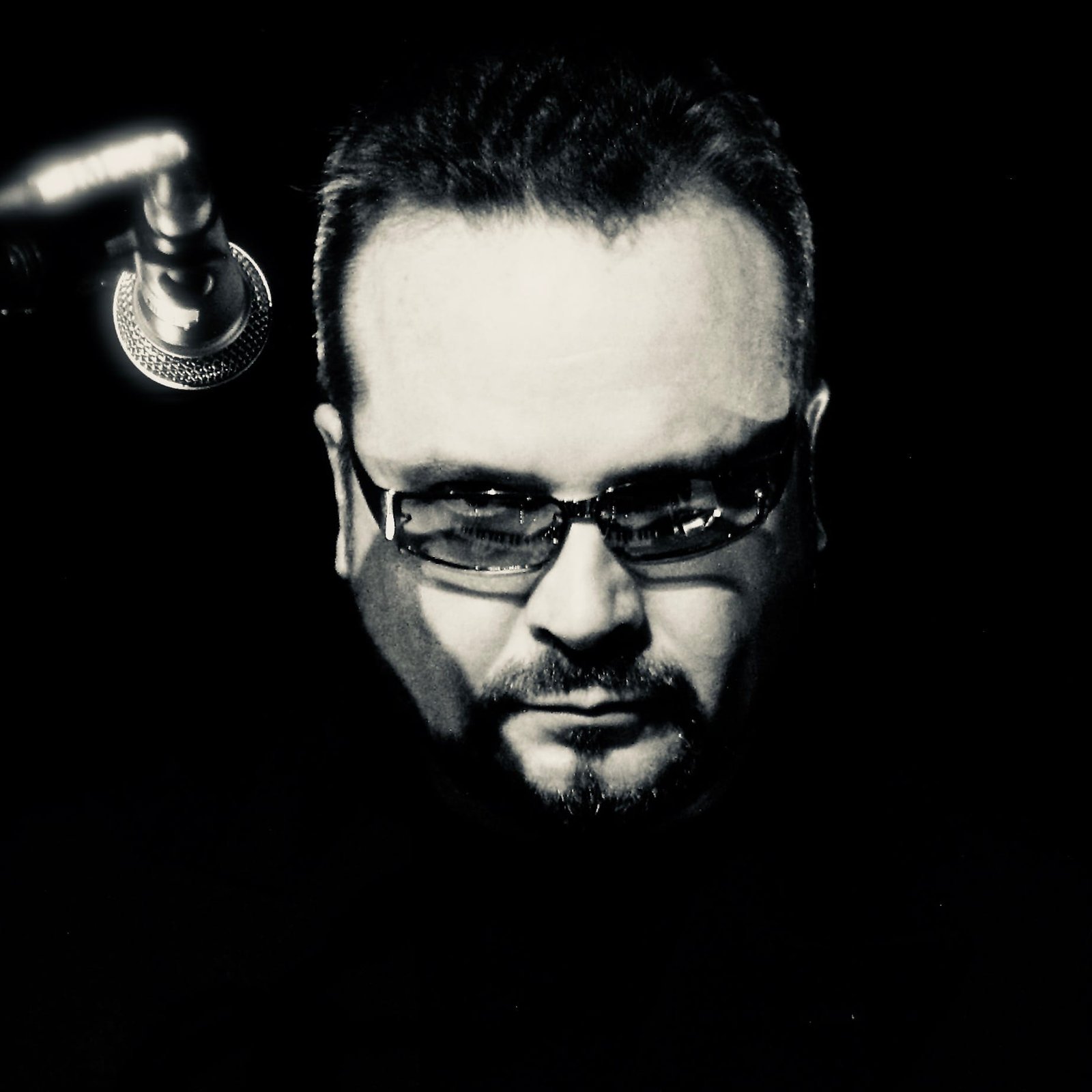
The musical career of Carlos Perón, one of the founders of the iconic band Yello, has been distinguished by its boldness and experimental spirit. After demonstrating his overflowing imagination in albums like Solid Pleasure and Claro Que Sí, he took a decisive leap with Impersonator, his first solo album, releasing one of the most unclassifiable works of the era. Since then, Perón has fully devoted himself to his solo career, composing music for fetish events, creating soundtracks, and releasing albums in genres ranging from ambient and experimental to industrial and trance. In our new interview, he shares insights about some of his most recognized works. Carlos will be one of the highlights of the Ombra festival, where he will perform next Saturday, December 6th.
 —Our first question is about your name and surname. Do you have any Spanish background?
—Carlos: In that sense, I don’t have a Spanish background, but rather an immense affinity for everything Spanish: language, art, history and gastronomy. The name comes from the Italian “Peroni” and evolved into “Perón” over time. It’s likely that when Lombardy was still part of the Swiss Confederation, the Peroni people immigrated to the original cantons. Through further emigration, the name “Perón” emerged, as can be seen in Paris, where many people with the surname Perón live. The hype claiming I’m the only living descendant of Evita Perón was started by the international music press. Se non è vero, allora va bene.
—In the 60s, you saw a concert of Karlheinz Stockhausen and you decided to produce electronic music after this. Also, you chose Kommunion und Intensitä as one of your favourite albums. How has Stockhausen influenced your way of making music?
—Carlos: For me, influences mean taking in knowledge. The concert back then was truly impressive. It took place at the Swiss Museum of Transport in Lucerne. Lights were installed under each seat, which illuminated when the steel plectrum was struck. The classical strings interacted miraculously with the industrial din, all played strictly according to the score, of course. I internalized this kind of music, sound, and noise so thoroughly that I felt the urge to make cassette recordings in industrial factories.
—Two albums that, according to you, changed your life come from the free jazz universe: Sun Ra’s Nuits de la Fondation Maeght and Larry Young’s Lawrence of Newark. Both artists/band leaders were keyboard players. Did they influence your way of playing or were they an influence in other ways?
—Carlos: When I was still playing with Urland, a kind of imitation of free jazz was all the rage at the beginning. I had collected many traditional instruments from my trips to Morocco. We experimented with this chaotic sound. It was exciting for a short time, but ultimately failed due to our lack of mastery of the instruments. I left the band during that period to pursue further musical studies. Larry Young (The Lawrence of New Ark), a magnificent organist who invented the distorted organ sound. There’s probably no record I collect more often. This ingenious eccentricity combined with tribal psychedelia. And yes, Sun Ra. I saw him live in Geneva and experienced the sun’s rhythms up close. It gets hot when you let yourself drift intensely. I also enjoyed his quirky stories about the universe. Perhaps that’s why I made my LP *Memories of the Future*, which is about the Anunnaki.
—Let’s start with the questions about your career. After playing keyboards in Urland, you created Tranceonic with Boris Blank. You said that during that time “What mattered was experimentation,” something that you have continued doing in your career. How was a normal day at the studio? Any of you came up with an idea and tried to develop it?
—Carlos: Right after the band Urland broke up, I packed up my equipment. Boris and I had been playing meditative ambient pieces on our own in the meantime, completely improvising, of course, so he asked if he could join me. So, after U.R.Q?, Astronic & Tranceonic we decided to build as our studio. The studio was quickly built, and we continued improvising as usual. One day, that wasn’t enough anymore, and we wanted to create pieces with substance. That’s how the song “America is Happy” came about. We met every Wednesday to create new pieces. Everyone could contribute what would make the piece cool and modern. Of course, I always cooked up special dinners, and we would then listen to the pieces on my hi-fi system to check them. We also went to discos with a cassette in hand and asked the DJ to play it. In the disco, we realized we were on the right track. Every day was special. Normal was only The Normal. We wanted to conquer the world, but not recklessly.
—With Yello, you signed with Ralf Records, the famous label created by The Residents. Why did you choose them, being an American label? Did you think the music of Yello fits their music approach?
—Carlos: At that time, Yello didn’t exist yet. As Tranceonic, Boris and I flew to the USA in August 1978 because we planned to get a record deal there. We chose RCA in Los Angeles, and in San Francisco we wanted to visit Chrome, the label behind Damon Edge. At RCA, we got a really good reaction to our tape; they wanted to keep it right away. That wasn’t possible, though, because we still had to go to San Francisco. Once in San Francisco, we mixed up the addresses and ended up on Groove Street at Residents’ place. We rang the bell several times, and an incredibly cool hippie girl let us in. There were tea and pot. She arranged for Hardy Fox and Jay Clem to arrive quickly and lead us into the Residents’ studio. We listened to the tape together, and our grins just kept getting wider. Hardy and Jay said it was great stuff and they’d like to make an LP. I said, “Cool, we can do that, but first we have to go to Mexico.” The story continues meticulously in Jonas Warstad’s books, *The Yello Chronicles 1976-1984*. Available on Amazon.
—With Tranceonic, you recorded a first version of Bostich. What can you please tell us about the composition of this track?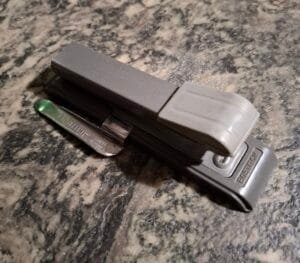
—Carlos: The original Bostich trigger sound came from an ARP Odyssey setting with linked ARP sequencers. The sound was like paper being stapled with a Bostich. That’s why I gave the piece that name back then. I knew what a “Bostich” was (is it actually spelled Bostitch). I’ve included a photo. Once the trigger was sorted, the creative overdubs came, like strings, bass, white noise, and shooting star sounds. The original version also featured a New Wave guitar and, of course, no Dieter Meier, because we didn’t even know who he was yet. The track was great for driving back then.
—With Yello you made a very innovative video, “The Evening’s young” and also you are credited to be the first artist who edited his music video from a movie. What can you please tell us about this?
—Carlos: Yes, the first Yello video was “The Evenings Young.” A stop-motion video. Dieter did the camera work, I handled the lighting and props. Basically, everyone did everything in Dieter’s office with his assistant, Peter. It was filmed on 16mm and edited by hand. For Dieter’s appearance, Swiss television even came with professional camera equipment. Dieter wanted to be seen in the best light. We even had a video premiere at the Frosch cinema in Zurich with a champagne reception and the city’s chic set. All of this coincided with the release of the Claro que si LP. After that came “Pin Ball cha cha,” which later ended up in the Museum of Modern Art in New York. I quickly learned the craft of video making. When I was working on “Commando Leopard,” my idea was to ask the producer, Erwin C. Dietrich, if I could edit a video from the film. He agreed and found the idea fascinating. It was then called “Original Video Soundtrack Commando Leopard.” In the US, I had a McDonald’s promotional video campaign; the clip ran in all McDonald’s restaurants across the country. It’s still a huge hit to this day.
—Your first album on your own was Impersonator, recently reissued by Mecanica Records. It’s quite a strange and unique record with influences from musique concrete. Was it easy to find a label to release such a different album? How was it received at the time?
—Carlos: My solo album Impersonator was signed to the competing label Konkurrenz by Tomi Richter at the time. Chris Lunch was also signed at the same time. The promotional material was 1/3 Yello or the skeleton of Yello. The competing label was founded by Phonogram International during the upcoming Neue Deutsche Welle (New German Wave), and since we had a deal as Yello with Phonogram, it was easy to get my solo album released on their label. There are now four Impersonator albums. Number 2 was on Play it again; Sam, number 3 was on Alfred Hilsberg´s Aus lauter Liebe, and number 4 was on EISENBERG/subculture. One day, José from Mecanica contacted me and wanted Aborted at Line 6, as well as Impersonator and Nothing is True; Everything is Permitted. It’s like this: the labels ask me if they may have this or that and if they’re allowed to release it.
—In 1982 you released a single with a band called Aborted At Line 6. I bought the reissue by Mecanica, but honesty I didn’t know that you were involved in this project: What can you tell us about this band with such an original name?
—Carlos: Yes, that’s very funny, apparently you overlooked the enclosed autograph card. It showed all the band members with what was essentially a passport photo. The project came about like this: At the time, I was working for a company that sold electronic goods like batteries, tape recorders, mixing consoles, etc. At the same desk sat Urs Steiger from Off Course Records, who was also the manager of Grauzone. The other members of the later project also worked there. There was also a ritual (unthinkable nowadays): everyone had to bring a bottle of Mumm Champagne in the morning, which was then divided up and had to be finished before the director arrived. This crazy idea gave rise to the idea for “Telion Boy”. Andy Fürer owned a studio with TEAC equipment. I was asked if I wanted to participate in the project Aborted at Line 6. Hesitantly, I agreed and then brought Chris Lunch along, and within two days the maxi-single was finished. I brought my equipment and we just started playing without a care in the world. Off Course Records quickly released the maxi-single, and this crazy idea turned into a genuine cult hit.
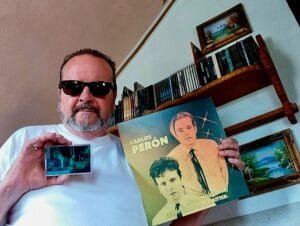 —Then you recorded a soundtrack (Die Schwarze Spinne ). How did you get into the world of soundtracks? Do you like the movies you make soundtracks for, or you don’t mind that?
—Carlos: The request for the score for *The Black Spider* came to Yello Sound Production by Mark M. Rissi. He envisioned a kind of techno with metal guitars. Since I was working on arena metal at the time, it was perfect for me, and my demo got me the job for the entire score. I produced it at Sunrise Studio together with Rissi. Back then, the mix was in mono for Lichtton. Later, I made a stereo version for the original soundtrack, which was then released worldwide by Milan Records. My school friend Chico Hablas played the guitars, of course, just like he did later for *Commando*. I love film soundtracks. I still buy them physically. The last one I got was for *TRON*, recorded by NIN. When I get a soundtrack commission, I always consider whether it somehow fits my style. Of course, I don’t do everything just for the money.
—One of you singles of that time was a dance classic. I am talking about Commando Leopard, and you defined it once as disco metal. And some of your works like Powerfrancefer were, let’s say, dancefloor oriented. Do you see your music as “dance music”? Do you think that most of it can be danced?
—Carlos: Sure, you can do dance moves to many of my tracks. But I don’t really make pure dance music. I don’t think about whether something is dance-compatible like some DJs do, for example, those who are dedicated to dance music. That would stifle my creativity. Of course, you need a super cool beat, but that flows naturally for me. I did POWERTRANCEFER for DINO Music. First, a maxi-single in a house/techno/acid style, Then the CD. The hit was Planetas viviendos. I have to say, at that time I’d already forgotten about techno, but it only really took off in Germany in the early 90s. Off course I did it. I then went on a rave tour for two years.
—Back again to dance music, one of the editions of your third album, Nothing is True, everything is Permitted comes with 33 RPM New Beat” versions. I read that some of these songs were played by DJs of the New Beat scene at a slower rpm. Do you know more about this?
—Carlos: Yes, even Wikipedia knows about this. The album *Nothing is true; everything is permitted* was released at the end of 1983 with the label marking “p. 1984.” That was label policy back then to keep the record current. I went to Ricco Sonderegger to have the record cut for vinyl. And lo and behold, the playing time was too long. There was also no way to cut the master tape. So, I decided to cut one side at 45 rpm and the other side the same music at 33 rpm. I called that the “World Cut.” Only the original release has this silver sticker on the sleeve. At that time, there was no such thing as New Beat or anything like that. However, in their confusion, DJs sometimes played 33 rpm and sometimes 45 rpm. The 33-rpm version (the slow, plodding one) later established the trend in Belgian New Beat. 1988 Kenny Gates from PIAS signed this all.
—As a producer you have worked with bands such as Wolfsheim, Second Voice or Eisbrecher. There are some producers famous for being quite intrusive, how do you consider yourself as a producer?
—Carlos: Good question, I think I’m both. Sometimes you have to intervene, sometimes you don’t; sometimes you just let it flow, and yes, that’s where the mixing of the project comes in. There are bands or musicians who have the talent to mix their songs, but many are faced with a mountain of challenges, and then you have to step in. If someone wants me to produce their music, they have to expect a certain Perón touch to come out.
—In 1992 you released Terminatrix, the soundtrack for a fetish performance in Cologne. How do you compose music for a spectacle like this? Did you do some “research” in the fetish scene before?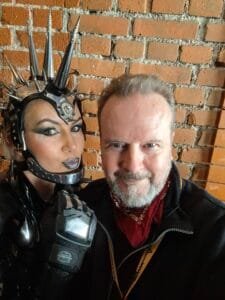
—Carlos: I’ve always had a weakness for elegant, fetish-oriented fashion. I didn’t need to do any research, as I was already quite familiar with the genre. In 1972, a well-known music journalist called me and asked if I’d be interested in composing music for a fetish show. I said yes, of course, only if the ticket prices were right. He then gave me the contact information to Techcom, the company that was going to organize the event. I made an appointment with the CEO, Peter W. Czernich, the inventor of the TERMINATRIX. Techcom published the renowned erotic magazine “O.” He told me about the storyboard for the TERMINATRIX show. I thought the idea was fantastic, and we came to an agreement. He provided me with the corresponding images, from which I was then to create the music. It was all incredibly exciting. About a month later, I had the show finished; all the staff were thrilled and full of praise for the music I had created. Then came the rehearsals for the live performance. The choreographer was Melvin Louis from New York. Ultimately, it was a Dance Fetish Fantasies show. Bose provided an octophonic mixing console and sound system. I could move the sounds from the stage across the ceiling, as well as left, right, forward, and backward. The television station Premiere from Hamburg filmed the whole thing like a sporting event. Shortly afterward, TERMINATRIX was released on CD and vinyl on my new label, 10,000 Zippers. 33 years later, I created a new TERMINATRIX for Peter W. Czernich and friends, which premiered at AVANGARDISTA in Munich on November 8, 2025. TERMINATRIX Ready to Shine is available worldwide on all digital platforms. Special edition CDs and vinyl releases will follow.
—Two years later, you commenced your “Salle” series with La Salle Blanche. These albums were included in 11 Deadly Sins, the compilation of your fetish albums. But here the music is a bit more ambient than the one founded in Terminatrix. How would you define the concept behind the “Salle” series?
—Carlos: Yes, exactly. To understand this, you need to know that Peter W. Czernich asked me if I could make a long fetish mix, because as far as he knew, something like that didn’t exist. I found the idea fascinating and got started right away in the studio. But I thought it needed a French narrator. That’s when I thought of my good friend from Neuchâtel, Tina Duvoisin. She ran a chic local radio station there, and she had an incredibly erotic voice. She then spoke in her divine French on the track “La salle blanche.” That was the first long fetish mix just as Peter had envisioned it. The CD was immediately released on 10,000 Zippers, and it was a huge hit till now. The sound became the standard at Domina Studios worldwide. I performed it at countless private and commercial fetish events. Then I had the idea to make “La salle violette” and other color “Salle”. The difference to the first TERMINATRIX is that the rooms were intended for playing, which requires mysticism, a mysterious atmosphere and lascivious voices, not pop/rock/techno/industrial compositions.
—Does humour belong in music according to Carlos Peron?
—Carlos: Oh yeah. I couldn’t live without humour and laughter in this sometimes bone-dry, degenerate business world. I love dry humour, even sarcasm. I always incorporate that into my music. For example, there’s the track “Navigator Wunderbar” (Wonderful Navigator). I had a BMW 730i with the first built-in navigation system. The voice sounded stern and distorted, almost like Adolf Hitler. I recorded it on DAT tape for 50 kilometres and had all the sayings on the tape. It would say things like “keep right,” “keep left,” “straight ahead,” or “roundabout ahead.” At the end of the track, it said, “You are leaving the digitized territory.” That’s enough to give you a laughing fit. And off course I love Spike Jones.
—Another curious album was Miles of Perón, an homage to Miles Davis. You also put On the corner as one of your favourite albums. How did you get the idea of doing it?
—Carlos: The phrase “Miles of Perón” came from a deceased fan/friend of mine. He knew I was deeply invested in Miles Davis and suggested it as an album title during a drinking session. Since I always write everything down, I rediscovered the note years later and decided to go for it. I had a young, ambitious assistant working in the studio at the time. I created a storyboard with the corresponding titles, and then we got started. I had a tribute to Larry Young, one to Mtume, and of course, to Miles. It’s Jazz Nouveau, after all. And yes, “On the Corner” is a must-hear for everyone.
 —Your last album was Start Again, recorded together with German band Melting Rust Opera. What can you please tell us about your last (if you haven’t released one, meanwhile I was writing the questions) album?
—Carlos: Melting Rust Opera has already released several tracks on DARK DAZE music INC. “Start Again” is by Carlos Perón with Melting Rust Opera. The singer from MRO asked me if I would make him a heavy metal track he could sing on. And I did. I built him an argent metal track in the style of “Suicide.” I’m currently working on a second track for him. It will be released in January. It’s similar to the collaboration with Captain Minigroove or Superstalin. They write the lyrics and sing, and I create the sound. Here are the most recent releases: Feuerherz by Carlos Perón & Captain Minigroove, Street date November 6, 2025 – Dreck weg! Carlos Perón & Captain Minigroove, Street date October 31, 2025 – TERMINATRIX Ready to shine streetdate November 9, 2025 – best to check my home page carlosperon.de
—Talking about industrial metal, you had a side project with Man Curtz called Dark Ruler, with which you released a couple of albums in the nineties. You also released a digital album called King of industrial. When did you start being interested in industrial music? Would you consider your first albums as “industrials”?
—Carlos: As I mentioned at the beginning, one of my passions was sound hunting. Before the term “industrial” existed, I created soundscapes so called Lärmbilder on tape or even laughter-filled orgies. With bands like Throbbing Gristle, the genre label “industrial” emerged. Since I liked the term, I later adopted it for myself. I have various monikers, for example, Fetish Pope or King of Industrial. This all comes from the music press. The album “King of Industrial” deals with industrial and ambient sounds combined with a touch of surreal psychedelia. I just have these bursts of energy when I’m pregnant with a concept, and then I just want to bring it to fruition. I allow myself to do that sometimes. Another lesser-known album is called “Carlos Perón Switched-on Bosch.” It’s not Bach like Walter Carlos later Wendy Carlos did. I illustrate the paintings of Hironimus Bosch, the famous painter. I was inspired by Vangelis‘ very dark album “El Greco.” DARK RULER was a precursor to Rammstein. Martin Curtz has sadly been deceased for some time now. RIP.
—After the interview-book Electro Shaman, you are writing another book about your life, right? Can you tell us more about this?
—Carlos: Yes, when time allows, I write about my memories. Since I kept a diary, I have a great archive. That much I can reveal. Currently, I’m 4 years old and I was able to bake my first pizza, and I refused to go to kindergarten.
—What’s next for Carlos Perón? Quantum computers and 32-bit hi-res in streaming?
—Carlos: Yes, absolutely. I can hardly wait. And compose directly from the dream into the DAW, of course. And next Album by Carlos Perón & Captain Minigroove $Electric Boomer Land$ street date December 6, 2025 on Saint Nicholas.
—With such a varied discography, what can we expect at Ombra?
—Carlos: I’ve put together a fantastic set for Ombra. It includes tracks from the 80s, 2000s, and some new, previously unknown hits. I’ve also created a video for the entire show that runs in sync; I won’t reveal any more than that.